An Explanation of Benefits (EOB) is a statement from your health plan explaining how it processed a claim—not a request for payment. Use it to check the provider's bill, the plan's payment and your share. Before paying, match the patient, provider, service date and claim details, then account for any copay or deposit you already paid.
The Centers for Medicare & Medicaid Services (CMS) explains the main fields and notes that an EOB may show patient responsibility without showing payments you have already made. Labels and layouts vary by plan; use the explanations on your own statement.
EOB versus medical bill: who sent it?
- EOB: Usually comes from the insurer or health-plan administrator. It explains a claim decision, insurer payment and patient responsibility.
- Provider bill: Comes from the doctor, hospital, laboratory or other billing organization. It asks for payment and should reflect insurance processing and payments already credited.
One visit can involve separate claims or bills from a facility, clinician or laboratory. Do not assume that a bill and an EOB describe the same services just because their dates are close.
Read these fields together
| Field | What to check |
|---|---|
| Patient, provider and date of service | Do these match the care you received and the bill you are reviewing? |
| Claim number and service description | Use the reference number when calling. Confirm which visit, test or treatment is included. |
| Provider charges / billed amount | The amount the provider submitted. It is not automatically your responsibility. |
| Allowed charges / allowed amount | The amount recognized for the service under the plan's processing rules. It may differ from the billed charge. |
| Paid by insurer / plan paid | The amount the plan pays for this claim. A low or zero payment does not, by itself, explain why. |
| Patient responsibility / what you owe | Your share according to this claim decision; compare it with the provider's bill and your receipts. |
| Remark or reason code | Read the code explanation, often at the bottom or on another page, rather than guessing what the decision means. |
A plan may separately list deductible, copay, coinsurance, non-covered amounts and adjustments. These labels do different jobs. See our health insurance cost guide for the underlying terms.
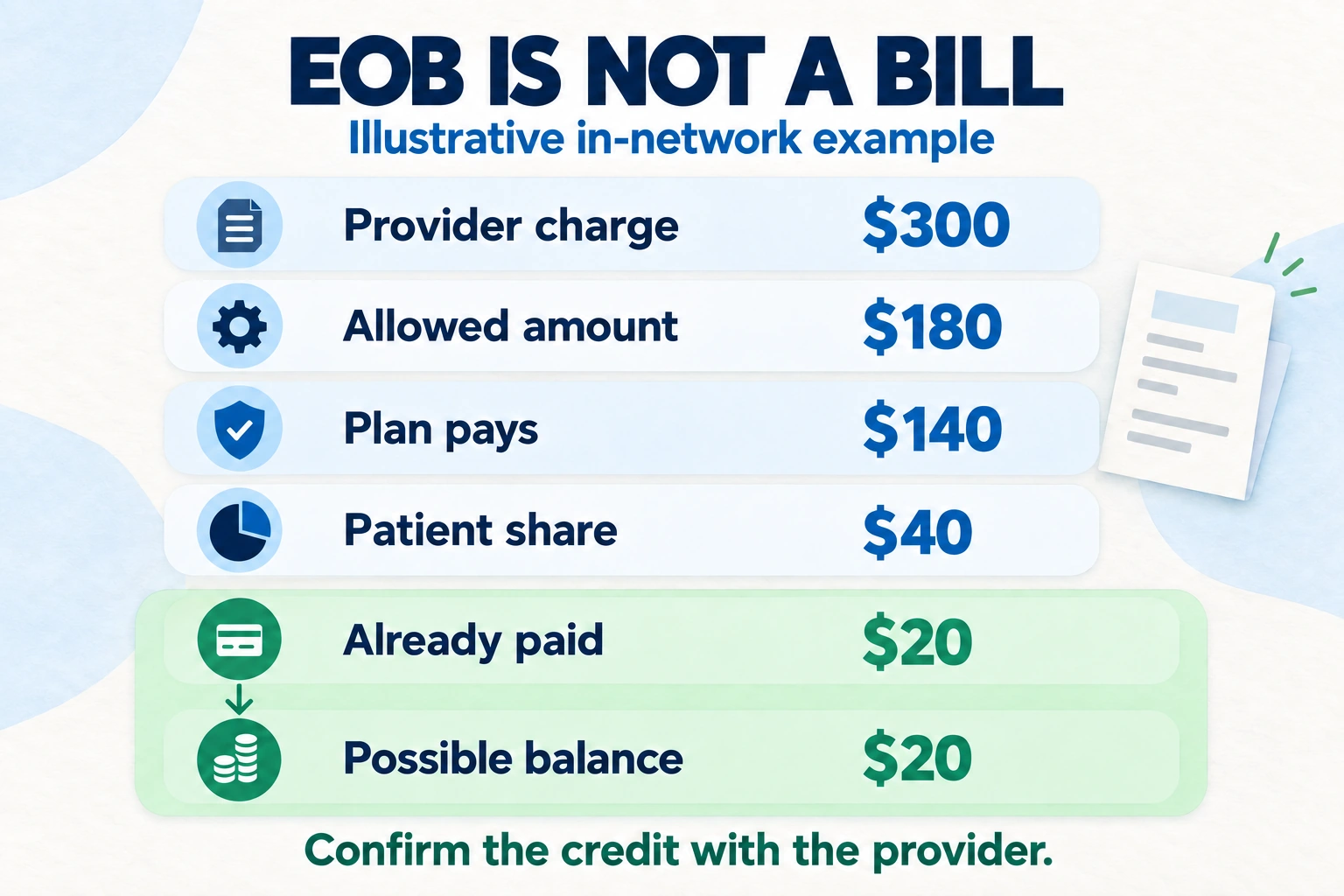
A simple example: avoid paying the same amount twice
Suppose an illustrative in-network covered claim shows a $300 provider charge, a $180 allowed amount, a $140 insurer payment and $40 patient responsibility. If the provider has already collected a $20 payment that applies to this service, the remaining balance could be $20—not $40. Ask the billing office to confirm the credit.
This example assumes the applicable contracted adjustment and no other charges or claim changes. Do not automatically apply it to an out-of-network, denied or non-covered service. The difference between billed and allowed amounts is not necessarily an amount you owe, but the actual treatment depends on the claim, contract and applicable protections.
Compare the bill in five steps
- Match the service. Check the patient, provider, service date and service description. Request an itemized bill if the charges are unclear.
- Check the claim status. Read whether the claim was paid, denied or needs more information. Ask whether a corrected or reprocessed EOB is expected.
- Compare patient responsibility. CMS says the provider bill should not be higher than the EOB's patient balance; if it is, contact the provider. First confirm that you are comparing the same claim and services.
- Subtract payments already credited. Locate copay receipts, deposits and payment confirmations. Ask the billing office to trace any missing credit.
- Keep a record. Save both documents, receipts, claim numbers, call notes and any corrected statements in a secure folder.
If the bill and EOB do not match, call both sides
Ask the provider billing office: “Which claim and services does this bill cover? Have you posted the insurer payment, adjustments and my earlier payment? Can you send an itemized bill and account balance?”
Ask the health plan: “What does this remark code mean? Is this the latest claim decision? Does the patient responsibility reflect a deductible, a coverage denial or another issue? Is correction, reprocessing or a formal appeal appropriate?”
A high patient balance is not always a denial
A covered service may still leave you paying a deductible, copay or coinsurance. Conversely, a zero insurer payment may reflect a denial or unresolved claim issue. Read the breakdown and reason codes before concluding either that the plan rejected the service or that every billed dollar is payable by you.
If you believe an out-of-network charge may involve federal surprise-billing protections, CMS lists the No Surprises Help Desk at 1-800-985-3059. Whether those protections apply depends on the service, coverage and circumstances; an EOB alone cannot resolve that question.
Medicare notices can look different
Medicare.gov's prescription-drug EOB page says the plan sends a monthly summary when you fill a prescription and recommends checking it for errors and contacting the plan with questions or suspected fraud. That is a drug-plan example, not a promise that all coverage uses the same format or mailing schedule. Follow the instructions for your particular plan or program.
This guide is general U.S. consumer education. It cannot determine the validity of a particular charge, claim outcome or legal protection. Plan terms and applicable law control; obtain case-specific explanations from the plan and provider.
Official sources to verify details
Confirm with your issued policy and the relevant government or regulatory body; rules vary by jurisdiction and plan.
- CMS — How to read a health insurance explanation of benefits — Primary federal guidance on EOB fields, patient balance, earlier payments and bill discrepancies; content checked October 3, 2026.
- Medicare.gov — Explanation of Benefits (EOB) — Official prescription-drug-plan notice guidance, including checking errors; content checked October 3, 2026.
Continue reading
Editorial note: Policy Made Clear provides general education, not personalized insurance, legal, tax, medical, or financial advice. We are not an insurer or agency. The issued contract and applicable law control your coverage.